
When you were a teenager, where did you find meaningful connections?
I was really into school growing up. While others were into partying and dating, I was totally focused on studying. My strongest connections were with other kids who liked to study.
I’m ethnically Iranian. My parents adopted me from Iran when I was a baby. My dad is German, my mom is American - they’re both white.
In high school, I was one of just a handful of brown people. I hung out mostly with the East Asian students. It didn’t occur to me until years later that my high school was so homogenous and that I didn’t really connect with the white kids.
What would you say was your first cross-cultural experience?
Really, from my earliest memories, all of my experiences were cross-cultural. In the [San Francisco] Bay Area, it’s hard not to be. I remember going to Palestinian festivals and all sorts of ethnic fairs and events. My parents really wanted me to know my heritage. We celebrated Persian New Year’s, I learned Iranian dance, and I took Farsi classes every Saturday. I was also fortunate to travel with my family, like tagging along on my dad’s business trips to Japan.
How did those experiences impact your school choices and career path?
I went to UC Davis and majored in genetics because I always wanted to be a veterinarian. I loved science, but as it turns out, I really don’t like euthanizing animals, which is a big part of it. So after I earned my degree, I took some time off from being a student and went to Japan to teach English for two years in Kyoto.
When I got back, I decided to combine my love of science with my love of teaching, and I pursued a Master’s in Education Learning Science and then taught high school science for four years. I parlayed that experience to become a researcher at UC Berkeley, digging into questions around how to teach science in ways that students learn best.
This led me to enroll in the MBA program at Berkeley’s Haas School of Business and turn my focus to educational technology. Along the way, whether as a teacher or as a student, in the East Bay or in East Asia, I always surrounded myself with others who loved learning. Wherever life takes me, that’s how I find community.
How were you introduced to Global Nomads?
I was living and working in NY and volunteering with a group that ran programs for Syrian refugee youth in Lebanon and Jordan. One of my neighbors in Brooklyn was on the Global Nomads staff. We clicked right away and did some projects together. First I consulted on the development of a science education program, and later we partnered to connect a classroom of Syrian refugees in Jordan with a classroom in the U.S. in a powerful Global Nomads cross-cultural dialogue.
In what ways does the Global Nomads mission resonate with you?
The mission is a natural fit for me – from my multi-cultural upbringing, to my embrace of international travel and languages, to my lifelong interests in education and technology.
Even though I was raised in the U.S., I identify as Persian first. I went to Iran for the first time in 2017, and I felt like I belonged – so much that I returned the following year and stayed for six months to study Farsi and immerse myself further in local culture.
Traveling throughout the Middle East also taught me about myself and revealed some of my more western sensibilities. I’m really used to a certain level and style of organization, structure, and control. I never got totally comfortable with what a friend of mine calls ‘controlled chaos’ in the way things get done there. I’d say that’s where I felt some culture shock.
Another thing I noticed that I really loved was how much the kids I met in the Arab world really enjoy being kids and seemed like they were in no hurry to grow up – which was a stark contrast to the teens I taught in the U.S.
How do you see bringing your experience to bear for Global Nomads?
Definitely around marketing. I’m pretty specialized in creating marketing machines, and many of the same principles and practices that apply in business apply to nonprofits. Content is big. Compelling content fuels successful marketing. Global Nomads has the content educators want and students need, and as a nonprofit, they are driven solely by the desire to meet those needs.
I love teaching and will always be a teacher at heart. I want to contribute to an organization that has the intention behind creating a true learning community, fostering student dialogue, and creating a bridge for people across the globe to connect.
At a moment when more and more connections are virtual, what sets Global Nomads apart?
When people exchange virtually, they are still doing it within their existing communities with people they know. They’re in echo chambers, talking with people with similar backgrounds and similar views – which I think actually makes them more disconnected from – and less understanding of the rest of the country and the broader world.
I’m reminded of this every time I travel abroad and post pictures and then hear from friends who are astonished because they had no clue what some of these places look like. When many people hear ‘Iran’ – they think ‘desert.’ They are surprised that the landscape includes jungles, beaches, and prairies. The architecture there is beautiful. The women don’t cover themselves, they are driving. People have a set of assumptions, which are often far from the reality.
Global Nomads is positioned to leverage virtual exchange to get young people out of their echo chambers to view the world. Travel is not possible for anyone right now – but even in non-quarantine times, travel is not accessible for everyone. Virtual exchange provides an alternative, accessible way for young people to connect - regardless of their resources - and experience global perspectives.
You’ve just stepped into your role as a board member, why take this on now?
I’m at a place in my life and my career where I can contribute what I know well to something I’m passionate about, that is part of my DNA. As a marketing specialist, I am eager to get Global Nomads programs to teachers hungry for high quality tools to engage their students and develop critical skills.
More broadly, I see myself playing an active role in generating interest and investment in the organization by connecting my professional and social networks with a community of people of purpose.
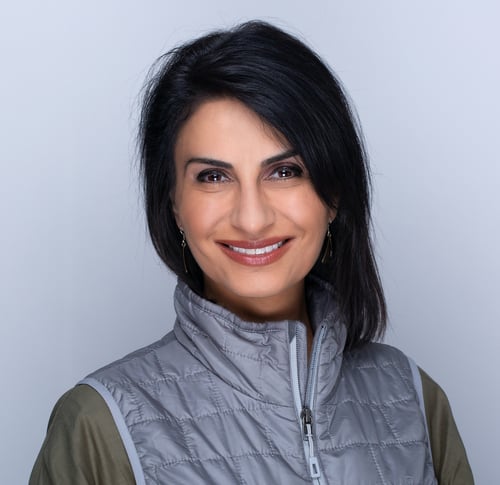
Kathy Shirin Benemann is Senior Vice President of Marketing at Feedzai, a company that uses artificial intelligence to prevent fraud and make banking and commerce safe. Kathy lives in the East Bay community of Walnut Creek, California with her two young cats, Roxanna and Finn, whose companionship she is grateful for - especially now during the coronavirus quarantine.